
How to Calculate Rental Property ROI (Temecula Guide)

Browse available homes in the Temecula Valley and see how real listings support a more accurate investment analysis.
A rental can look profitable on paper while maintenance, insurance, taxes, vacancy, and financing quietly reduce the return. That is especially important across the Temecula Valley, where investor decisions may differ between Temecula, Murrieta, Wildomar, Menifee, and Lake Elsinore.
To understand how to calculate rental property roi, divide annual net profit by the total investment cost, then multiply by 100. Start with realistic rental income, subtract operating expenses and vacancy, and account for the cash you actually contribute. This approach follows the standard ROI definition used across finance and real estate education.
The result is not a prediction or a universal pass-fail score. It is a decision tool that helps you compare properties, test assumptions, and see which operating choices improve long-term income. In the Temecula Valley, that analysis begins with understanding why the same percentage return can carry different meaning from one local market to another.
Why Rental Property ROI Matters for Temecula Valley Investors
Rental property ROI gives Temecula Valley investors a consistent way to compare opportunities, rather than relying on purchase price or projected rent alone. It connects income, operating costs, financing, and upfront cash into one decision-making framework. That clarity matters in a market where small assumptions can materially change the result.
Temecula Valley investors should evaluate ROI against the full cost of owning and operating a property. Include maintenance, insurance, taxes, vacancy, management, and financing where relevant. A property that appears attractive because of strong rent may produce a weaker return after realistic expenses. The University of San Diego emphasizes reviewing income, operating expenses, and cash flow in a complete property analysis: real estate investment property analysis.
The local numbers make this discipline especially important. Median home prices across the Temecula Valley commonly fall within the $725,000 to $850,000 range, while the market has approximately 4.2 months of inventory, suggesting relatively balanced conditions. At that entry cost, investors need to understand whether rental income supports the capital required and the risks assumed.
- Compare properties consistently: Use the same income and expense categories for a Temecula single-family rental, a Murrieta home, or a property in Wildomar, Menifee, or Lake Elsinore.
- Separate growth from cash flow: A market can offer long-term appreciation potential without producing a high immediate return.
- Test assumptions: Model vacancy, repairs, taxes, insurance, and management before making an offer.
Demand patterns also support a forward-looking approach. About 77% of Riverside searches come from buyers outside the market, and Riverside County has grown 4.5% since 2020. Those indicators point to continued relocation interest, but they do not guarantee a specific property's performance. Investors still need property-level math.
That is why ROI should be viewed as a comparison tool, not a promise. Mogul Real Estate's local team can help investors assess neighborhood conditions, acquisition costs, and operating assumptions across the valley. The goal is to identify a return that fits your strategy and remains credible when actual expenses arrive.
How to Calculate Rental Property ROI for a Temecula Valley Rental
Rental property ROI becomes useful when the calculation reflects the cash you actually commit and the income the property produces after expenses. Start with a simple percentage, then refine it with acquisition costs, repairs, financing, and operating performance.
The basic formula is (Net Profit / Cost of Investment) x 100. ROI is a performance measure that helps investors evaluate an investment's profitability and compare opportunities using a consistent framework.
Step 1: Calculate annual net profit
Begin with the property's realistic annual income. Include collected rent and other recurring income, then subtract operating expenses. Those expenses can include maintenance, insurance, property taxes, utilities paid by the owner, management, advertising, and an allowance for vacancy.
Do not confuse gross rent with profit. A rental earning $36,000 in annual rent does not produce $36,000 of profit if the owner pays taxes, insurance, repairs, management, and other costs. A complete property analysis considers income, operating expenses, and cash flow together. The University of San Diego outlines this property-level analysis approach.
Step 2: Define your total investment
For an all-cash purchase, the cost of investment may include the purchase price, closing costs, initial repairs, and other upfront costs. For a financed purchase, investors often calculate cash-on-cash return separately, using the down payment and actual out-of-pocket costs. Label your method clearly so you do not compare unlike percentages.
A more complete upfront investment calculation is:
- Down payment or cash purchase amount
- Closing costs, lender fees, and inspection expenses
- Initial repairs, improvements, and furnishing
- Any required reserves or upfront operating costs
Step 3: Run the calculation
Suppose you invest $100,000 in a rental, including the down payment, closing costs, and repairs. After operating expenses, the property produces $9,000 in annual net profit. The calculation is ($9,000 / $100,000) x 100, which equals a 9% ROI.
For Temecula Valley investors, consistency matters because purchase prices, rents, repairs, and management needs can differ across Temecula, Murrieta, Wildomar, Menifee, and Lake Elsinore. Use conservative assumptions, record each expense, and update the estimate as you receive property-specific numbers. A local brokerage team can help you validate those assumptions before you commit; meet Mogul Real Estate's team.
Cap Rate vs. Cash-on-Cash Return: Which Number Matters More
Cap rate and cash-on-cash return answer different investment questions. Cap rate evaluates the property's operating performance before financing. Cash-on-cash return evaluates the cash you personally have invested after considering debt service. Use both metrics to understand a Temecula rental from the property level and the investor level.
Cap rate divides net operating income by the property's value or purchase price. Net operating income includes rental income after normal operating expenses, but before mortgage payments. Cash-on-cash return divides annual pre-tax cash flow by the cash actually invested, including the down payment and eligible acquisition costs.
| Metric | What it measures | Formula | What it ignores | Best for |
|---|---|---|---|---|
| Cap rate | Property-level operating yield | Net operating income / property value | Mortgage payments, down payment, and financing terms | Comparing properties on an unlevered basis |
| Cash-on-cash return | Annual cash return on invested capital | Annual cash flow / cash actually invested | Appreciation, principal paydown, and changes in property value | Evaluating the effect of financing on your cash |
Why financing changes the answer
Suppose two Temecula properties produce the same net operating income. Their cap rates may match even when one investor makes a larger down payment or receives a different interest rate. The properties look identical operationally, but the investors may experience very different annual cash returns.
Financing can increase cash-on-cash return when reasonable leverage leaves enough income after debt service. It can also reduce or eliminate cash flow when the loan payment, rate, taxes, insurance, vacancy, and maintenance consume too much of the rent. A higher cash-on-cash result is not automatically safer.
Local investors should compare financing scenarios rather than relying on one quote. Test a larger down payment, a different interest rate, and realistic reserves. Then examine whether the projected cash flow remains workable if rent, repairs, or vacancy perform below expectations.
Which metric should a Temecula investor use?
Start with cap rate when screening homes across Temecula, Murrieta, Wildomar, Menifee, and Lake Elsinore. It helps separate operating performance from the financing structure. Move to cash-on-cash return when you know your capital position and loan terms. For a complete analysis, calculate both and document every income and expense assumption.
These metrics are part of the broader process of calculating rental property ROI. Neither captures every outcome. Appreciation, tax treatment, principal reduction, and future selling costs require separate analysis before making an offer.
A Worked Example: Rental Property ROI on a Temecula Rental
A useful rental ROI example should include the purchase price, upfront cash, operating expenses, financing, and realistic rent. The result may be less attractive than a headline estimate, but it gives you a defensible basis for comparing properties.
- Set the purchase assumptions. Consider an illustrative Temecula single-family rental purchased for $700,000. That price sits near the lower end of the broader Temecula median home-price range of approximately $725,000 to $850,000. Assume a 25% down payment of $175,000, $14,000 in closing costs, and $10,000 for initial repairs. The total cash invested before operations is $199,000.
- Estimate gross rental income. Temecula city median rent is approximately $2,262 per month, while the metro median is about $1,877. Using $2,262 as the estimated monthly rent produces annual scheduled rent of $27,144. This is a starting assumption, not a promise. The home's condition, floor plan, neighborhood, school boundaries, and included amenities can move achievable rent higher or lower.
- Subtract vacancy and operating expenses. Apply a conservative 5% vacancy allowance, or $1,357 annually, leaving $25,787 in collected rent. Next, assume $2,800 for property taxes and insurance, $1,500 for maintenance, $1,000 for utilities and landscaping, and $2,064 for professional management. Total operating expenses, including vacancy, are $8,721. The resulting net operating income is approximately $18,423. A complete analysis must account for income, operating expenses, and cash flow, rather than relying on rent alone (property analysis guidance).
- Calculate the cap rate. Cap rate compares NOI with the property's purchase price. Divide $18,423 by $700,000, then multiply by 100. The estimated cap rate is 2.63%. This figure evaluates the property before mortgage payments, so it helps compare properties with different financing structures.
- Calculate cash-on-cash return. Assume a $525,000 loan at an illustrative 7% fixed rate over 30 years. Principal and interest would be approximately $3,493 per month, or $41,916 annually. Subtracting that debt service from the $18,423 NOI produces estimated annual pre-tax cash flow of negative $23,493. Divide that result by the $199,000 cash invested. The estimated cash-on-cash return is negative 11.8%.
- Separate current return from potential future gain. An investor could model loan principal reduction, rent changes, or appreciation, but those outcomes require separate assumptions. For example, adding an estimated $4,000 of first-year principal reduction would still leave a negative current return of about 9.8% on the original cash invested. Do not treat appreciation as guaranteed income.
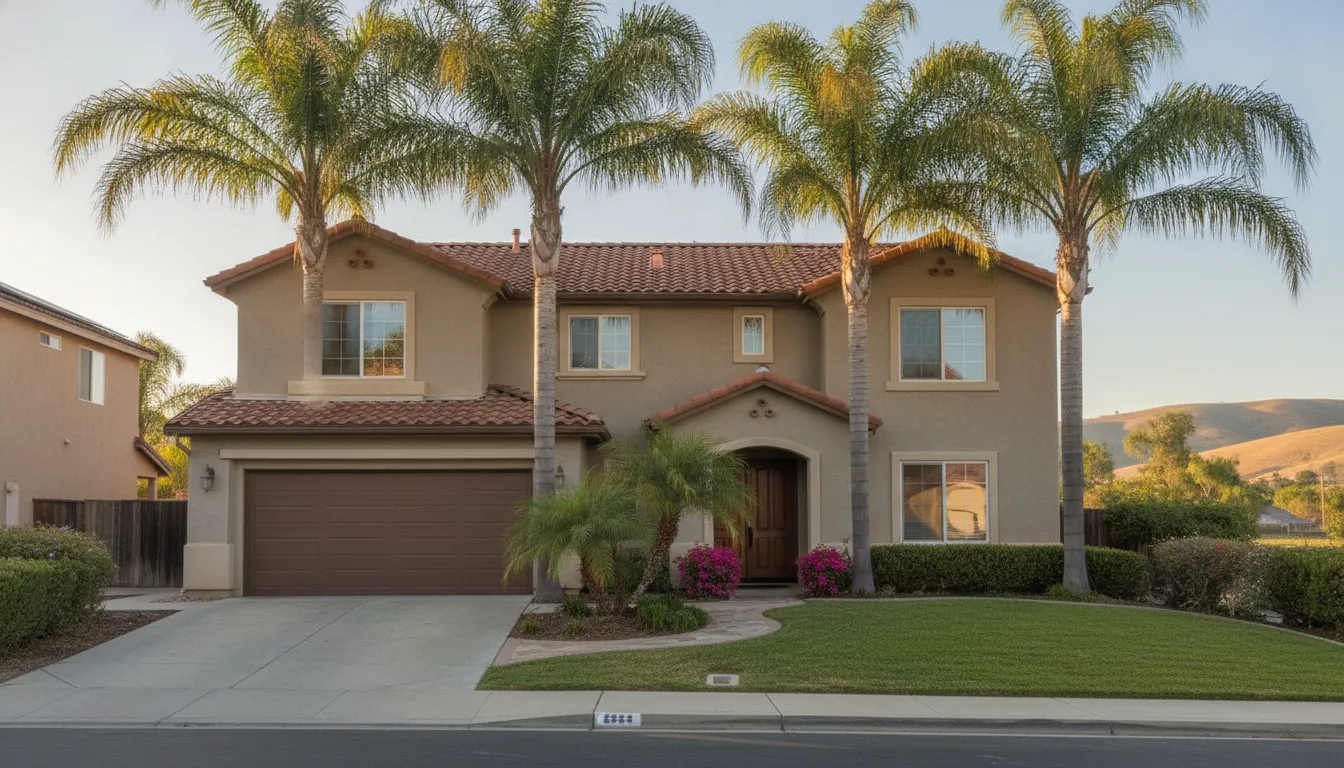
This example shows why ROI calculations should use net profit and total investment, not gross rent alone. In Temecula Valley, a property can make sense for long-term appreciation, tax strategy, or owner use while producing weak initial cash flow. Test multiple rent, vacancy, expense, and financing scenarios before making an offer.
What Is a Good ROI on a Rental Property?
A good rental property ROI is often discussed as roughly 8% to 12% annually, but no benchmark applies to every investor. In Temecula Valley, a lower initial return may still make sense when the property offers durable demand, manageable expenses, and a credible path to appreciation.
ROI measures how efficiently your invested money produces profit. Start with annual net profit, then divide it by your total investment and multiply by 100. That calculation is useful only when your profit estimate includes realistic operating costs, financing, vacancy, maintenance, insurance, taxes, and management.
Why the 8% to 12% benchmark needs context
The commonly cited 8% to 12% range can serve as a screening reference, not a promise. A property that reaches 10% on paper may underperform if the rent estimate is optimistic or the analysis excludes repairs. A property returning 6% may be stronger if its assumptions are conservative and its location supports stable occupancy.
High-appreciation metropolitan markets frequently produce lower cap rates than markets where prices are less competitive. Temecula, Murrieta, Wildomar, Menifee, and Lake Elsinore each have different purchase prices, rents, tenant demand, and expense profiles. Investors should compare the return against the risk and the amount of cash required.
That is why learning how to calculate rental property roi matters more than copying a single target percentage. Use the same assumptions across multiple properties, then test what happens if rent falls, vacancy rises, or a major repair occurs. A range of outcomes gives you a more useful decision than one optimistic forecast.
What determines whether an ROI is good?
The right target depends on your strategy and financial priorities. Before calling a projected return good, review these factors:
- Location: Neighborhood demand, schools, commute access, and local amenities can influence rent, vacancy, and resale potential.
- Financing: Interest rate, down payment, loan terms, and closing costs change both cash flow and cash-on-cash return.
- Appreciation: Potential price growth can matter, but it should remain an upside scenario rather than a guaranteed part of your return.
- Cash flow goals: An investor seeking monthly income may choose a different property than one focused on long-term wealth building.
Finally, distinguish between gross and net ROI. Gross rent does not show what you keep. Include recurring expenses and a reserve for irregular costs before evaluating the result. Professional management can also affect the calculation because better operations may reduce overhead, protect occupancy, and improve long-term rental income.
How to Improve Your Rental Property's ROI in Temecula
Improving rental ROI usually comes from several operational decisions rather than one dramatic change. Set rent from current market evidence, protect occupancy, control expenses, and preserve the property's appeal. In Temecula Valley, integrated professional property management can connect those decisions and help reduce overhead while supporting long-term rental income.
Start with rent positioning. Compare similar homes by neighborhood, bedroom count, condition, parking, outdoor space, and included utilities. A rent that is slightly below the market may increase inquiries, but pricing too low leaves income on the table. Pricing too high can extend vacancy and create a poor first impression when listings sit online.
Review the property as a renter would. Clean, functional spaces attract stronger applicants and can support more consistent renewals.  Minor upgrades often offer better risk-adjusted returns than expensive renovations, especially when they improve durability or reduce recurring maintenance.
- Replace worn fixtures, dated lighting, or damaged flooring where the improvement is practical.
- Improve curb appeal with low-maintenance landscaping, fresh mulch, and clean walkways.
- Address plumbing, heating, cooling, and appliance issues before they become emergency repairs.
- Use durable materials in high-traffic areas to reduce replacement frequency.
Tenant quality also affects the return calculation. A consistent screening process can reduce the risk of missed payments, avoidable damage, and costly turnover. Screening should follow applicable fair housing requirements and use the same documented criteria for every applicant. Clear lease terms and prompt communication can further support reliable occupancy.
Vacancy reduction deserves its own line in your analysis. Track renewal timing, response speed, showing volume, and the days between tenants. Begin renewal conversations early, resolve legitimate maintenance concerns, and make move-in expectations clear. Retaining a qualified tenant can protect income when the costs of cleaning, marketing, repairs, and lost rent are included.
Cost control does not mean deferring necessary work. It means separating preventive maintenance from discretionary improvements, comparing vendor pricing, and reviewing recurring bills. Keep records for taxes and performance analysis. Property-level income, operating expenses, maintenance, insurance, and taxes all influence the cash flow used in an ROI calculation.
For owners who do not want to coordinate these details alone, NL Property Management provides an integrated operational lever through Mogul Real Estate. Professional management can organize leasing, maintenance coordination, tenant communication, and rent administration under a consistent process. That structure may lower avoidable overhead and help maximize long-term rental income, which improves the net profit side of the ROI equation. Learn more about the brokerage and its connected services through Mogul Real Estate.
Recalculate the property after each meaningful change. Compare annual net income, vacancy, maintenance costs, and management expenses against the total investment. This keeps the decision grounded in the property's actual performance instead of relying on gross rent alone.
Common ROI Calculation Mistakes Temecula Investors Miss
Reliable rental property ROI depends on complete inputs, not an optimistic rent estimate. Temecula investors can overstate returns by leaving out operating costs, misreading financing effects, or treating one performance measure as the entire investment story.
Understated expenses are one of the most common problems. A realistic projection should account for routine maintenance, repairs, vacancy between tenants, utilities paid by the owner, insurance, property taxes, licensing, supplies, and reserves for larger replacements. Even when a property appears occupied today, future turnover can reduce annual income.
Use the cash you actually invest
Another mistake is calculating returns from the purchase price while ignoring the cash required to acquire and operate the property. Include the down payment, closing costs, initial repairs, furnishings, lender fees, and other upfront expenses. If you finance the purchase, include interest and loan-related costs in the annual cash-flow analysis.
This distinction matters because leverage changes the amount of cash invested and the expenses paid each year. A loan may improve the return on the investor's cash, but it can also reduce monthly cash flow and increase risk. Compare the projected result with the cash that truly leaves your account, not a simplified purchase-price figure.
Do not confuse cap rate with total return
Cap rate measures a property's net operating income against its price before financing. It can help compare operating performance, but it does not capture loan payments, changes in property value, principal reduction, or the cash return on your invested funds. Treating cap rate as total ROI can produce an incomplete decision.
Total return may include annual cash flow, loan principal paid down, and appreciation when the property value rises. Appreciation is not guaranteed, so model it as a separate scenario rather than presenting it as certain income. A conservative case, base case, and stronger case can show how much the result depends on future market conditions.
- Leaving maintenance, vacancy, utilities, or replacement reserves out of operating costs.
- Using the purchase price instead of the investor's complete cash investment.
- Ignoring financing costs, principal reduction, or the effect of leverage.
- Calling cap rate the same as total investment return.
- Assuming appreciation will occur without testing a no-appreciation scenario.
- Failing to budget for professional property management and leasing support.
Budget for professional management
Self-management can look free when the calculation includes no value for the owner's time. In practice, leasing, resident communication, inspections, maintenance coordination, and compliance work have real costs. Omitting them can make a rental appear more profitable than it would be under a professional management model.
Include a management allowance in every Temecula projection, even if you may manage the property yourself. Then compare the result with the operational support available through NL Property Management. Mogul's local real estate team can help investors evaluate the assumptions behind the model before they commit capital.
Frequently Asked Questions
Should I include mortgage payments when calculating rental property ROI?
Include mortgage principal and interest when measuring cash-on-cash return or annual cash flow. For a broader property-level view, calculate operating income separately, then compare both measures so financing does not hide the property's underlying performance.
What expenses should I include in a Temecula rental ROI calculation?
Include property taxes, insurance, HOA fees, maintenance, utilities paid by the owner, vacancy, leasing costs, and property management. Also budget for major replacements, such as roofs or heating and cooling systems, rather than treating them as unexpected exceptions.
Is the 2% rule realistic for Temecula Valley rentals?
The 2% rule is a screening shortcut that compares monthly rent with the purchase price. It should not replace a full analysis. Temecula, Murrieta, Wildomar, Menifee, and Lake Elsinore properties require local rent, vacancy, financing, tax, insurance, and maintenance assumptions.
What is a good annual ROI for a rental property?
There is no universal answer because risk, leverage, condition, and appreciation potential differ by property. Compare the projected return with your required return, stress-test lower rent and higher expenses, and confirm that the investment still works without relying on optimistic assumptions.
Rental property ROI becomes more useful when you evaluate real listings with realistic income and expense assumptions. When you are ready to compare potential opportunities across Temecula Valley, browse available homes in the Temecula Valley and take the next step with a clearer investment framework.